The 6-Again: Flawed Logic & Hypocrisy

FinestTigers

Well-known member
As a long-time Wests Tigers fan, I’ve absolutely hated the 6-again rule since the day it was introduced. It opened the floodgates for arbitrary officiating, and watching our games, the bias in how and when it’s applied couldn't be more blindingly obvious.

Are games decided by penalties in soccer? Yes. Winning a penalty is often the single most decisive moment in a 90-minute match.
Are games decided by 6 agains in NRL? Yes. Statistically, receiving a high volume of 6-agains early in a match correlates with winning because it induces severe middle-forward fatigue in the opposition, breaking open defensive structures.

Tactical Execution in the First 50 Minutes.
A biased whistle doesn't show up in the overall count, it shows up in the timing and location. In the opening hour, the referee repeatedly hits the favoured team’s opponent with 6-agains inside their own 20-meter zone, and on the 5th tackle in the set. This inflicts immediate physical exhaustion, destroys defensive line speed, and guarantees the favoured side flies out to a commanding 18-to-24 point lead.

Cosmetic stat-balancing: By full-time, the stat sheet reads a clean 6–6 or 7–6 restart split. The referee gets to point to the numbers as proof of impartiality, completely hiding how the early, targeted blowtorching physically ruined one team long before the "pity" calls were handed out. Handing a gassed team a 6-again in the 72nd minute when they're down by 20 points isn't fairness, it's an insult. The referee spends 50 minutes draining your gas tank, then hands you the ball when you can barely stand up, just so the post-match stats look balanced.
 
Fair point, but It’s not about needing a conspiracy every week, it’s about how a soft whistle kills a vulnerable team's chance to even stay in the contest.

if we look at the rule , and don’t buy into any conspiracy theories … it has sped up the game and removed the wrestlemania element .., Bellamy and the Storm must hate it ..,

It can be too zealously applied at times and by certain refs …

If the rule it was removed I would still hate Klein making it all about himself
 
I hate the 6-again rule too but we weren't the worst offenders. However, some teams were much smarter than us. They would either hold onto a player on the first 6 again play to slow down the ruck or build ongoing fatigue.

I've said this before and I'll say it a thousand times again, PVL has turned the game into a two sided horse race, with no consideration for strategy or gameplay.

Screenshot 2026-10-28 at 3.34.43 pm.png
 
I don't mind the logic, I don't want teams slowing the ruck down and being offside, we've experienced the Storm carry on and I didn't like it.

And I think the 6 again rule helps the Tigers.

In the past we rarely win the ruck and have slow line speed, so 6 again calls help us with monentum and field position.

No 6 again calls in the GF, certainly didnt help Newcastle
 
Last edited:
The NRL’s Player Welfare Hypocrisy
The National Rugby League frequently preaches its commitment to player safety, concussion management, and workload reduction. Yet, the introduction and retention of the 6-again rule exposes a glaring hypocrisy.

1. Unprecedented Workloads Under Peak Exhaustion
Forcing athletes to make 18 to 24 consecutive tackles without a stoppage drives cardiovascular and muscular fatigue to dangerous levels. Pushing players to physical exhaustion increases the risk of soft-tissue injuries and joint failures.

2. Increased Concussion & Head-Injury Risks
The NRL claims head contact prevention is its highest priority. However, medical research consistently shows that fatigue is a primary contributor to poor tackle technique. When defenders are gasping for air with leaden legs, their head positioning drops, their lateral movement slows, and the risk of head-on-hip or head-on-knee contact skyrockets.

3. Subjective Officiating Weaponized Against Welfare
By replacing a clear, objective penalty whistle with an arbitrary wave of the hand, the NRL created a rule with zero accountability.

You cannot claim to care about player welfare while running a system that deliberately starves athletes of oxygen, forces them into tackle fatigue where concussions thrive, and hides behind a subjective rule that ruins the integrity of the contest.
 
I hate the 6-again rule too but we weren't the worst offenders. However, some teams were much smarter than us. They would either hold onto a player on the first 6 again play to slow down the ruck or build ongoing fatigue.

I've said this before and I'll say it a thousand times again, PVL has turned the game into a two sided horse race, with no consideration for strategy or gameplay.

View attachment 45851
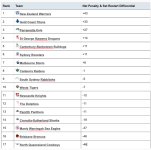
Surprised roosters are in the green
 
Duty of Care or Duty of Broadcast?

The more I look into this topic the more I am shocked and the more I find the NRL in a deep policy contradiction.

In official sports epidemiology and NRL injury surveillance reports, concussion statistics are tracked in two ways, diagnosed concussions per match/per 1,000 player-exposure hours and Head Injury Assessments (HIAs) performed per match.

When looking at the numbers from the 2019 season (the last full year before the 6-again rule) through the post-6-again seasons, the data reflects a sharp upward trajectory in on-field head impact events and medical interventions.

HIAs Have Nearly Doubled. The number of players pulled off the field for a Head Injury Assessment per game has risen from 1.3 in 2019 to nearly 2.4 per match in recent seasons.

Detection vs. Mechanism. The NRL claims this increase is purely due to better detection technology and independent doctor spotters. However, sports science studies highlight that the propensity for tacklers to suffer head-to-hip or head-to-knee impacts increases under peak fatigue, the exact physical environment created by continuous 6-again sets.

The Policy Contradiction. While medical detection protocols have tightened significantly, the on-field rule structure remains unadjusted, forcing players into continuous tackle sets that heighten the risk of fatigue-induced head collisions.

On One Hand (Medical Strictness), Recognizing that head injuries were climbing as the game sped up, the NRL was forced to introduce draconian HIA protocols, independent match-day doctors, mandatory stand-downs, and stricter high-tackle crackdowns.

On the Other Hand (Accelerated Fatigue), By keeping the 6-again rule, which prioritizes high-speed, continuous broadcast entertainment, they maintained the exact physical mechanism (extreme, unbroken fatigue) that degrades tackle technique and makes players more vulnerable to head knocks in the first place..

The 6-again rule isn't about player welfare or game integrity, it's about television speed and discretionary referee power. You cannot claim to prioritize concussion safety while enforcing a rule that intentionally starves athletes of oxygen, ruins their tackle technique through fatigue, and gag orders anyone who points out the danger.
You raise some really good points with the 6 again rule being done for game speed and television rights and questioning if it is impacting player welfare.
You've not made any points in regards to match integrity as per your original post.
 
You raise some really good points with the 6 again rule being done for game speed and television rights and questioning if it is impacting player welfare.
You've not made any points in regards to match integrity as per your original post.
You are correct gregim87.
I just tried to keep my post from getting any longer.

For a sporting contest to maintain true competitive integrity, rules must be clear, auditable, and applied equally without granting the referee the ability to subjectively determine match outcomes. The 6-again rule undermines game integrity across four major areas.

1.The Loss of Transparency and the "Audit Trail"
Before 2020, every time a referee penalized a team in the ruck or offside line, the whistle blew, play stopped, and the decision was broadcast clearly to players, coaches, commentators, and fans.

The 6-Again System (Untraceable), A wave of the arm for a 6-again happens live while play continues. There is no official stoppage, no pause for replay, and no challenge mechanism for captain's calls. This removes accountability, an official can award 3 or 4 subtle restarts in a row based on subjective "ruck speed," and it cannot be reviewed or disproven.

2. Extreme Subjectivity & "Phantom" Officiating
Rugby league rules regarding the ruck, such as "peeling off too slowly," "hand on the ball," or "not moving clear", are inherently subjective.

3. The Illusion of Equal Statistics ("Cosmetic Equalization")
Game integrity is severely damaged when match statistics mask what actually happened on the field.

4. Distorting Natural Competition and Skill
Sports are meant to be decided by athletic execution, skill, and tactical strategy, not by manufactured momentum shifts, In modern NRL, field position and fatigue dictate who wins. By repeatedly resetting the tackle count for one side inside the attacking 20-meter zone, the referee effectively forces defensive collapse.

Game integrity relies on rules being objective, equal, and auditable. The moment you introduce an unreviewable, subjective rule that allows a referee to control team fatigue and match momentum without leaving a paper trail, you move away from genuine athletic competition and toward manufactured entertainment.
 
I don't mind the logic, I don't want teams slowing the ruck down and being offside, we've experienced the Storm carry on and I didn't like it.

And I think the 6 again rule helps the Tigers.

In the past we rarely win the ruck and have slow line speed, so 6 again calls help us with monentum and field position.

No 6 again calls in the GF, certainly didnt help Newcastle

So you don't want to increase the number of penalised infringements?

What do you think happens if you don't penalise infringments?

Do you want to see more slowing down of the ruck with the wrestle, other ruck 'tricks' and increased line speed by being off side?

Do you want less 'ball in play' time?

No doubt it went overboard at the start of the season but IMO that doesn't mean it's flawed logic.
We Already Had Tools to Fix the Ruck, The Sin Bin.

The maximal deterrent to cynical wrestling and intentional slowing of the ruck isn't a silent wave of the arm, it’s a 10 minute spell in the bin.

If a team repeatedly flops, wrestles, or stays offside inside their own 20m, the referee has the authority to march a player to the sin bin. Teams would stop cynical wrestling overnight if doing it meant playing 12 on 13 for 10 minutes. The NRL introduced 6 again as a cheap shortcut instead of forcing refs to use the judiciary and sin bin properly.
 
I'd be happier if I knew what the 6 again was for .....
Maybe instead of the sound effect they currently use , they use a different sound effect for every 6 again indiscretion so you know what it is
 
We Already Had Tools to Fix the Ruck, The Sin Bin.

The maximal deterrent to cynical wrestling and intentional slowing of the ruck isn't a silent wave of the arm, it’s a 10 minute spell in the bin.

If a team repeatedly flops, wrestles, or stays offside inside their own 20m, the referee has the authority to march a player to the sin bin. Teams would stop cynical wrestling overnight if doing it meant playing 12 on 13 for 10 minutes. The NRL introduced 6 again as a cheap shortcut instead of forcing refs to use the judiciary and sin bin properly.
They clamped down on the rules, fabric of the game ,they called it at the time while Cleary was coaching us/the team .
They just about had all team game plans changed for the better 2/3rd s into the year then dropped it
Now we have PVL Ball, wonder what rule changes will be introduced 2 wks b4 kick off this year
 
You are correct gregim87.
I just tried to keep my post from getting any longer.

For a sporting contest to maintain true competitive integrity, rules must be clear, auditable, and applied equally without granting the referee the ability to subjectively determine match outcomes. The 6-again rule undermines game integrity across four major areas.

1.The Loss of Transparency and the "Audit Trail"
Before 2020, every time a referee penalized a team in the ruck or offside line, the whistle blew, play stopped, and the decision was broadcast clearly to players, coaches, commentators, and fans.

The 6-Again System (Untraceable), A wave of the arm for a 6-again happens live while play continues. There is no official stoppage, no pause for replay, and no challenge mechanism for captain's calls. This removes accountability, an official can award 3 or 4 subtle restarts in a row based on subjective "ruck speed," and it cannot be reviewed or disproven.

2. Extreme Subjectivity & "Phantom" Officiating
Rugby league rules regarding the ruck, such as "peeling off too slowly," "hand on the ball," or "not moving clear", are inherently subjective.

3. The Illusion of Equal Statistics ("Cosmetic Equalization")
Game integrity is severely damaged when match statistics mask what actually happened on the field.

4. Distorting Natural Competition and Skill
Sports are meant to be decided by athletic execution, skill, and tactical strategy, not by manufactured momentum shifts, In modern NRL, field position and fatigue dictate who wins. By repeatedly resetting the tackle count for one side inside the attacking 20-meter zone, the referee effectively forces defensive collapse.

Game integrity relies on rules being objective, equal, and auditable. The moment you introduce an unreviewable, subjective rule that allows a referee to control team fatigue and match momentum without leaving a paper trail, you move away from genuine athletic competition and toward manufactured entertainment.
I see arguments similar to point 1 often, but I very much disagree with it. We live in an error where live tv can be paused and rewound and every game is broadcast. Every 6 again decision is time stamped on the NRL website as is the reason for that decision. If anyone wants to audit any decision it is not difficult to do. Maybe a little bit timely and not going to achieve anything, sure, but not untraceable. The decisions can very much be reviewed and proven right or wrong.
Accountability still exist through audits of every game done internally by the refereeing team. This is no different to pre-2020. Referees answer to their bosses the same now as they did then, no amount of replays in the past or absence of them now has changed this.
Yes there is no means of challenging on the run i.e. captains challenge but again this is no different to pre 2020 when no decision could be challenged.

I somewhat agree with point 2. I actually think the parameters for the many different ways that defenders are to be penalized for slowing down the play the ball are quite clear, you've listed a couple of the obvious ones in hand on ball or peeling. Some others include clearing through the ruck and leg pull.
Things like holding down to long or crowding however can be more subjective as you say. So are most the rules in NRL, not just ruck infringements. It is simply the nature of the game.

I think 3 is simply based on vibes. Without some actual evidence that stats are manipulated late in games I'm not sure it is worth discussing. But let's assume that there is a trend of one team getting a glut of late calls to balance the stats there is other explanations for why eg A team with a lead deliberately breaking the rules in order to smother the opposition attack and maintain their lead. As 6 agains come with possession we would expect to see calls come in waves, rather than alternating one by one between sides.
If someone brought some actual statistical evidence i'd think it might be interesting to analyse but for all the online complaints I'm yet to see any.

I agree with point 4 to an extent. I think we sometimes see teams fatigue an opposition into conceding points rather than break down the defensive with creativity. I do however believe most 6 agains are earnt through manipulating the defence to a point where they feel they need to concede 6 again to reset their line. They referee does not determine the fatigue due to 6 agains, the defenders do by committing the infringement.

So I disagree with you conclusion. The rules are objective and auditable and should be equal (though refereeing is as poor as it has ever been so one team will always get the better rub). The 6 again rule is not unreviewable and has a clear paper trail. Whilst each decision is subjective it is the same subjective rules that existed beforehand. It is how it has been penalised that has changed not the ruling itself.

I'm not defending the 6 again. I don't like it and never have. I agree with it putting player safety at greater risk and leads to a worse overall product. I also believe it has led to worse refereeing outcomes due to greater referee fatigue.
 

Latest posts

Members online

No members online now.
Back
Top