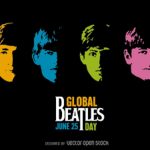
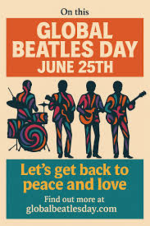
Global Beatles Day “fab fours” itself onto our calendars each June 25. This year marks a massive milestone because Apple Corps Ltd. - the band's official multimedia company - has formally recognized and endorsed the celebration for the first time since its fan-led creation in 2009.
The date commemorates June 25, 1967, when John Lennon, Paul McCartney, George Harrison, and Ringo Starr performed "All You Need Is Love" live on the BBC's
Our World program. This historic event was the world's first live, international satellite television broadcast, reaching an estimated 400 million viewers.
Fans across the globe invited to take part in Global Beatles Day online or at in person events - spreading The Beatles’ message of love and unity.
On 25th June, 1967, The Beatles, John, Paul, George and Ringo, walked into Studio One at Abbey Road Studios in London and sent a message to the world. Broadcast live as part of the BBC’s Our World, the first international satellite television broadcast of their song, “All You Need Is Love” reached an estimated 400 million people around the globe. For a few extraordinary minutes, the world was watching together.
Decades later in 2009 lifelong fan Faith Cohen decided this day deserved to be commemorated. From that belief, Global Beatles Day was born. A fan-made, fan-run celebration dedicated to the band, their music, and a message that continues to resonate across generations and around the world: love is all you need.
From tribute concerts in Tokyo to Beatles-themed exhibitions in New York City, singalongs in Buenos Aires, and fan gatherings in Liverpool, Global Beatles Day has continued to grow organically. Its growth has been built on an enduring love for John Lennon, Paul McCartney, George Harrison and Ringo Starr and their message, and evolved into an annual event embraced by fans spanning generations and continents.
Now, in a major milestone for the celebration, Apple Corps Ltd, the company founded by The Beatles to manage their creative and business ventures, has formally acknowledged Global Beatles Day.
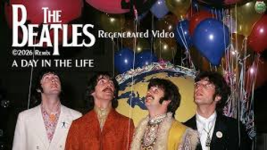
This year, On 25th June, alongside online and in-person events around the world that celebrate the band, The Beatles will also release a colourised version of their BBC Our World performance of “All You Need Is Love
” for free on YouTube. The first time the iconic performance has been made available online, it will celebrate the iconic performance’s anniversary, mark Global Beatles Day, and give fans around the world the chance to relive that spectacular, global moment from 1967 and share their reaction in the live chat.
Writing to Faith Cohen this week, Apple Corps CEO Tom Greene praised the fan-led initiative, writing: “
More than ever, the message of The Beatles, and of ‘All You Need Is Love’ speaks to something vital for community, connection, and the power of bringing people together. That is what makes Global Beatles Day so special. It asks nothing more than for people, wherever they are, to stop, listen, and share a little joy.”
The recognition feels fitting for a band whose enduring impact remains unparalleled.
The Beatles remain one of the most successful and influential acts in history. More than five decades after their split, their music continues to resonate across generations, from fans who lived through Beatlemania in the 1960s to new audiences discovering
Hey Jude and
Let It Be through streaming and social media or
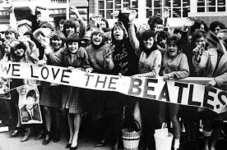
The Two of US, currently used in the hit film Project Hail Mary. Beyond record sales, they reshaped fashion, youth culture, songwriting and album production, sparked the “British Invasion” in America, and redefined popular music with groundbreaking albums like Sgt. Pepper's Lonely Hearts Club Band.
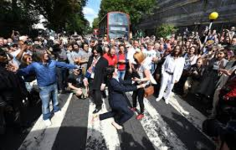
Their legacy continues to draw millions of visitors to landmarks such as Abbey Road Studios, where fans still flock to recreate the iconic Abbey Road crossing photo. In an announcement made earlier this month 3 Savile Row, the location of their iconic rooftop concert, is to be made into the first official fan experience, opening in 2027. Looking ahead, an eagerly anticipated four-film Beatles cinematic event is set for release in April 2028 through Sony Pictures Entertainment and Neal Street Productions. The project marks the first time Apple Corps Ltd. and The Beatles have granted full life story and music rights for a scripted film. Directed by Sam Mendes, it will star Harris Dickinson (John Lennon), Barry Keoghan (Ringo Starr), Paul Mescal (Paul McCartney) and Joseph Quinn (George Harrison).
Global Beatles Day started as a simple idea that has become a global movement built on joy, togetherness and connection, values that feel increasingly relevant today. And on 25th June, millions of fans worldwide are expected to do exactly what Global Beatles Day encourages: celebrating The Beatles, their music, and a message that continues to resonate across generations and around the world: love is all you need.
The band remained very popular around the world even after they broke up. According to the
Guinness Book of World Records, they are the highest-selling recording artists ever. They have sold over one
billion records, including
albums and
singles. Their
music is still important and influences many musicians today. Artists still perform
cover versions of Beatles songs. People everywhere still listen to their music. Their song 'Yesterday' has been recorded by more artists than any other song. It is also the most played song on radio ever.
Their music was revolutionary across the world’s musical landscape:
- Innovative: Pioneered studio techniques, music videos, and concept albums (e.g., Sgt. Pepper's Lonely Hearts Club Band).
- Eclectic: Blended rock and roll with psychedelia, Indian classical, and symphonic pop.
- Melodic: Known for soaring, unforgettable vocal harmonies and catchy hooks.
- Versatile: Shifted seamlessly from the upbeat pop of "I Want to Hold Your Hand" to the introspective "Yesterday".
In 2026, the living members of The Beatles, Paul McCartney and Ringo Starr, are in their 80s. The two deceased members, John Lennon and George Harrison, would have been in their 80s as well. There again, as all music fans know, Beatles music is timeless.
Global Fan Events in 2026: Organizers are coordinating synchronized listening parties, street busking, tribute concerts, and mass sing-alongs spanning major hubs from Liverpool and London to New York, Buenos Aires, and Tokyo.
Today, remember everything Beatles and celebrate Global Beatles Day wherever you are in this great southern land, because ……..
All You Need is LOVE.
Fun Facts about The Beatles:
- John Lennon and some friends started a band called the Quarrymen in 1956. Over the next few years, the band members changed. By 1960, the group was known as The Beatles. Their first big hit song came out in 1962.
- The melody for one of the most covered songs in history, "Yesterday," came to Paul McCartney completely finished in a dream.
- A Hard Day's Night is the only Beatles album where all of the songs were solely written by John Lennon and Paul McCartney.
- In April 1964, they occupied all top five spots on the Billboard Hot 100 chart simultaneously, a record that remained unbroken for nearly 60 years.
- The Beatles made thirteen albums and twenty-six singles together. They also started their own record label, Apple Records. They made two movies where they acted: A Hard Day's Night and Help!. Later, they made Magical Mystery Tour, a television special. Yellow Submarine was a cartoon movie based on their music. Let It Be showed them working on a new album.
- Ringo was the narrator for some of the Thomas the Tank Engine TV series.
- The Beatles' last live concert was in 1966. It was at Candlestick Park in San Francisco.
"Life is what happens while you’re busy making other plans"
"The Beatles saved the world from boredom"
“And, in the end the love you take is equal to the love you make”
“The Beatles were just four guys that loved each other. That’s all they’ll ever be”