Joy Milne, a retired nurse from Scotland, first noticed a distinct, subtle "musky" smell on her husband,
Les, about 10 to 12 years before he was officially diagnosed with Parkinson’s disease in 1994.
At the time, she didn't connect the odor to any medical condition, assuming it was just sweat or a change in his body chemistry.
It wasn't until years later, when attending a Parkinson's support group with Les, that Joy realized every person in the room shared that exact same distinct scent, prompting her to believe that Parkinson's disease carried a unique olfactory signature.
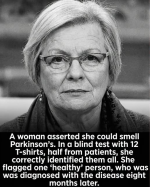
Intrigued by her claim, researchers at the University of Edinburgh, led by Dr. Tilo Kunath, decided to test Joy's ability through a double-blind study. Joy was given 12 plain T-shirts, six worn by confirmed Parkinson's patients and six worn by healthy control subjects. Joy correctly identified all six Parkinson's patients, but she also insisted that one of the control group members had the disease.
Although marked as an error initially, the story took an incredible turn eight months later when that specific control subject was officially diagnosed with Parkinson's, revealing Joy had a 100% accuracy rate and had detected the disease long before clinical symptoms appeared.
Joy's extraordinary olfactory sensitivity, a condition known as hyperosmia, led scientists to investigate what compounds she was actually smelling. Researchers discovered that the distinct odor stems from volatile chemical changes in sebum, the oily substance secreted by the skin, which is altered by Parkinson's disease.
Joy’s gift has since paved the way for scientists to develop early diagnostic tools, including skin swabs and mass spectrometry tests, aimed at identifying Parkinson’s years before motor symptoms begin.

 www.bbc.com