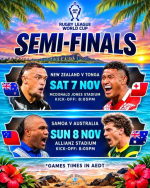
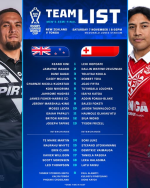
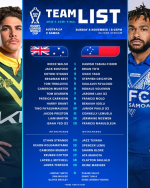
2026 Rugby League World Cup fixtures - October/November

What does the word 'fair' mean in this context and the way the sentence is structured? When was Advance Australia Fair written and what did 'fair' mean in this context in those times?
That’s a very fair question (pardon the pun).

It's a great angle to explore. To address those valid concerns, it helps to look at how national symbols evolve over time, moving from their original 19th-century context to a modern expression of unity and shared community.

1. Acknowledging the Original 19th-Century. Context. It is historically accurate to acknowledge that when Peter Dodds McCormick wrote the song in 1878, the lyrics reflected the social norms and colonial mindset of the Victorian era. The Colonial Perspective: Terms like "young" and references to British allegiance in the original four-verse version reflected a 19th-century view focused primarily on European settlement, The Evolution of "Fair": While early usage carried multiple layers, including poetic terms for beauty ("a fair land"), fairness, and 19th-century cultural descriptors, it was tied to the colonial context of its day.

2. How the Anthem Evolved to Include Everyone. Rather than remaining frozen in 1878, Advance Australia Fair has been deliberately updated over time so that it reflects the entire nation, not just its colonial origins. Inclusive Language (1984): When officially adopted as the national anthem in 1984, gender-exclusive lines were updated (e.g., changing "Australia's sons" to "Australians all" to embrace every member of society. Recognising Ancient History (2021): The official change from "for we are young and free" to "for we are one and free" was a significant step toward unity. It explicitly acknowledges over 60,000 years of Indigenous heritage while affirming that all Australians share a single, united present and future.

3. What "Fair" and the Anthem Mean Today?
Symbols gain their true strength from what they mean to the people singing them today. In modern Australia, the anthem stands as a call for unity, mutual respect, and shared opportunity. The "Fair Go": Today, "fair" is inextricably linked to the iconic Australian value of a "fair go", the principle of fairness, equality, compassion, and equal opportunity for everyone, regardless of background or origin. A Bridge for Unity: The core message of the anthem today, "for we are one and free", is fundamentally about togetherness. It doesn't ask people to erase their unique cultural, Indigenous, or ethnic heritages, instead, it provides a shared platform where all Australians can stand together as one community.
 
I think at $2.75 tonga can produce a big upset against New Zealand and are terrific value

Think Australia get the job done against Samoa

Kangaroos out to $2.30 to win the world cup, outstanding value

Australia v Tonga in the final is my pick with Australia to win
Australia probably win the whole thing but atleast it’s not a certainty like in the pasT

All four teams have a genuine crack at winning the thing imo. What will hurt Samoa and Tonga though will be their 1, 6,7 and 9 not being as elite as the Aussies and Kiwis spine
 
I think it will be a similar story to Fiji. Fiji played their grand final against Australia and had nothing left.

Tonga v Samoa was their grand final. I don't see Tonga beating New Zealand.
Agreed, Tonga will give it to them physically for the first 20-25 minutes and have NZ on the ropes for a bit

Then they’ll ultimately run out of puff with NZ winning 26-10 or something .. my prediction anyways
 
The way the use of fair is structured in the anthem, it's not clear what it means which leaves it open to interpretation like that of above. Below is straight from Google AI:

Historically the word 'fair' meant light-coloured and was deeply entwined with concepts of beauty, goodness, and purity. The linguistic evolution of "fair" reveals a powerful intersection where physical appearance, class privilege, and moral superiority merged over hundreds of years.

Originally, the word had nothing to do with skin tone or justice. It derives from the Old English word fæger, which meant "beautiful," "pleasant," or "attractive to the eye".

During the Middle English period (around 1200), "fair" began shifting to specifically denote light complexions, blonde hair, and light eyes.

European aristocracy did not work under the sun. Having pale, un-tanned skin was a prominent status symbol that separated the wealthy ruling class from the tanned, lower-class laborers.

As the word became tethered to light skin, it simultaneously absorbed heavy moral overtones.

By the 1300s, "fair" began to mean "equitable, impartial, and free from bias" (as in fair play or a fair trial). Linguists and essayists note that this was a deliberate, cultural alignment: what was physically light and "beautiful" was naturally associated with what was morally right, pure, and just

Conversely, the word "black" or "dark" was systematically given the opposing linguistic baggage, evolving in the 1580s to mean "hostile, evil, or having dark purposes".

Literature heavily reinforced this. For instance, in William Shakespeare's sonnets, the idealized, morally pure romantic interest is referred to as the "Fair Youth," while the untraditional, earthly, and complicated temptress is dubbed the "Dark Lady." [1]

The modern legacy of this linguistic evolution survives today. While "fair" is most commonly used in daily speech to mean "just," its secondary meaning as a descriptor for light skin ("fair-skinned") still directly carries the historical remnants of an era that explicitly linked paleness with purity and goodness.
 
I think it would probably kill the international game. I believe most would pick origin over Samoa/Tonga. These matches would then be back to the nothing events they were in the past with a bunch of 2nd rate players. Not sure many would care about the new 3 match series in this case.
If they choose origin over their Test country then their hypocrisy will be on full display. They need to fully committ for it to work.
 
Had to laugh on the NRL website the teams for both Australia and Samoa are listed along with all reserves but only the Samoan coach is mentioned and no Aussie coach.It is obviously only an error but it does highlight the fact that Walters has no idea.
 
I personally still feel Hammer in the centres, Sua at fullback and Mariner on the wing is a better mix for Samoa.

Does anyone know why we are persisting 8pm on Sunday night? I understand the heat but considering Samoa, Tonga and NZ are all ahead of us in the timezones, it'd be 10pm for them.

Maybe it rates better on TV on Sunday nights..
It would 100% be the broadcasters, I don’t think IRL would have any say.. I think it’s ridiculous too

Sunday 4pm makes sense IMO
 
I personally still feel Hammer in the centres, Sua at fullback and Mariner on the wing is a better mix for Samoa.

Does anyone know why we are persisting 8pm on Sunday night? I understand the heat but considering Samoa, Tonga and NZ are all ahead of us in the timezones, it'd be 10pm for them.

Maybe it rates better on TV on Sunday nights..
I understand chanel 7 as broadcaster can dictate to IRL of time they want to play
frustrating it isnt friday 8p and Saturday 8pm
 
Back
Top