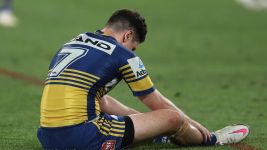
Bin there, done that: Johns critiques sin bins and officiating after Easter Monday controversy
The fallout from Parramatta's dramatic Easter Monday clash with the
Wests Tigersdominated discussion on
Freddy & the Eighth, with
Brad Fittler and Andrew Johns questioning both the sin bin decision and broader officiating consistency.
The match itself delivered high drama.
The flashpoint came in the second half, when Tigers
Luke Laulilii was sent to the sin bin following a mid-air collision that left Parramatta's
Bailey Simonsson with a dislocated ankle — an injury that could sideline him for the remainder of the season.
What followed proved decisive in shaping the match.
With the
Wests Tigers down to 12 men, the
Parramatta Eels immediately capitalised on the numerical advantage.
Debutant Apa Twidle crossed for two quick tries — including one on his very first touch in the
NRL — both coming down the edge left exposed by Laulilii's absence in the sin bin.
Despite that momentum swing, the Tigers regrouped and ultimately secured a gritty extra-time victory, but the sin bin period remained a crucial turning point in the contest.
Laulilii now faces a one-match suspension after entering an early plea to a grade two dangerous tackle charge, though both Fittler and Johns were adamant the punishment didn't fit the act.
“I didn't think that was a sin bin. I just thought it was horribly unlucky,” Fittler said.
“He went up to compete for the ball. Parramatta player got inside him. What are you supposed to do? He's just competing for the ball.
“I don't think he (Laulilii) did anything to worsen the position or hurt the player.”
Johns echoed the sentiment, adding his own perspective on aerial contests.
“I've never jumped for a bomb for obvious reasons,” Johns joked.
“But I'd imagine if you went up for a bomb and you didn't get it for whatever reason, your instinct is to grab hold of something.
“It's not intentional.”
The pair agreed that while the outcome was serious, the act itself lacked malice, and that modern interpretations may be too heavily influenced by injury.
“I think 10 minutes nowadays is too long,” Johns said, supporting a suggestion raised on the show that a five-minute sin bin could be more appropriate in certain cases.
“Any hit to the head which isn't a send off, no problem with 10.
“I just think a professional foul now is 5 minutes.”
Both legends ultimately agreed that “Accidents happen.”
The discussion also revisited similar incidents earlier in the season, including a contest involving
Dominic Young and
Savelio Tamale, where a sin bin was issued.
Fittler noted the key difference in that case was the act of grabbing, which constituted a clearer infringement.
They contrasted the aerial collision with hip-drop tackles — another hot topic this season — pointing to J'maine Hopgood's ACL injury as an example.
While hip drops are often not malicious, they stem from poor technique and fatigue, with players aware of the inherent risk.
In contrast, competing for a high ball remains an unavoidable and fundamental part of rugby league.
Perhaps the most pointed criticism from the show centred on inconsistency in officiating, particularly when injuries are involved.
Fittler highlighted another incident from the same game, where
Sean Russell rushed out of the line, failed to properly complete a tackle, and collided head-on with a Tigers player, knocking himself out in the process.
Despite the dangerous nature of the contact, only a penalty was awarded.
According to Fittler, the outcome could have been very different had the opposition player come off worse.
He argued that if the Tigers player had been concussed instead, Russell may have faced time in the sin bin — or even a send-off — exposing a reactive approach to officiating based more on injury outcome than the action itself.
It's a concern that continues to divide the game: whether punishment should be based on intent and action, or the severity of the consequence.