And today is .......

International Sudoku Day puzzles onto our calendars each September 9. International Sudoku Day was officially established in 2013 by the World Puzzle Federation. They believed September 9th was the most appropriate day since the game consists of a 9 x 9 grid of numbers.

Today highlights the classic, logic-based number-placement puzzle enjoyed by millions around the globe. Whether you are a lifelong solver or a complete beginner, today is the perfect day to challenge your brain with a new grid.

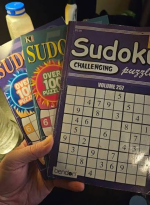
Sudoku is played on a 9x9 grid divided into nine 3x3 sub grids, totaling 81 individual cells. The goal of the game is to fill every row, column and 3x3 box with the numbers 1 through 9. No number can repeat within the same row, column, or 3x3 box. Every puzzle comes with pre-filled numbers and the more numbers provided at the start, the easier the puzzle is to solve.

From casual beach solvers to elite international competitors, Australians have a vibrant and unique connection to Sudoku. The puzzle is a staple of Australian morning routines, competitive sport culture, and elite athletic preparation.

A morning cup of coffee isn't complete without the daily Mind Games section of national papers like The Australian or the Herald Sun.

Sudoku has also carved out a niche in elite Australian sports culture. Australian Dolphins commonwealth swimmer Alex Perkins famously uses Sudoku as a core part of her pre-race preparation. She treats the puzzle as a form of "active meditation" to escape the intense pressure of the pool.

Beyond being a fun and engaging pastime, playing Sudoku offers several great benefits:

It exercises logical reasoning and helps keep your brain active, which benefits mental health.

Provides a calming, meditative break from daily distractions. The strict rules and grid layout require gentle, single-focused concentration. This active meditation blocks out distracting thoughts and emotional overwhelm. Sitting down for 15 to 30 minutes to fill in a grid acts as a quiet, meditative break from daily stress.

Helps with focusing and critical thinking.

Solving each small square or completing a section gives an immediate reward. This provides the brain chemical dopamine.

A Sudoku puzzle is easy to carry on a phone and fills empty waiting times with a fun challenge.

The logic-based rules rely on visual patterns rather than big blocks of text, which fits well with how many neurodivergent brains process information.

Sudoku is not an exclusive test for high IQ, as solving it relies heavily on practice, logic, and learned techniques rather than general intelligence.

Doing puzzles regularly helps create a higher baseline of mental function, meaning your brain stays active and adaptable.

Studies show older adults who solve puzzles often have better short-term memory and faster processing speeds.

The most common Sudoku mistake is guessing instead of using logical deduction, which often ruins the entire puzzle several steps later.

Playing Sudoku every day improves your logical thinking, strengthens your memory, and gives you a calm, focused mental break.

Replacing phone scrolling with a quick paper or digital puzzle helps wake your brain up in the morning or wind down at night.

2008 World Sudoku Championships – Our Aussie Connection​

In 2008 a group of former University of Western Australia Rugby Club players decided to form a team to send to the World Sudoku Championship in Goa, India despite three of the four team members, Mick Colliss, Hamish Sutherland, Mark Skiffington and Sandy Sutherland, not having played the game before. Dubbed the Numbats, after a small Australian marsupial, the four worked to gain corporate sponsorship for their endeavour. They eventually raised enough money to cover their trip and to provide distinctive uniforms including sporting blazers that closely resembled those worn by Australia's team at the 1936 Olympic Games.

At the championships the team finished last.

In 2009 team vice-captain Mick Colliss wrote a book, published by HarperCollins Australia called Full Contact Sudoku based on the team's experience in Goa.

A documentary Colour by Numbers detailing their exploits aired on ABC Television in April 2010.

Our brains are always searching for more.

Sodoku can be the map to keep the journey going.


Fun Facts about Sudoku:
  • Sudoku was formerly called "Number Place." It was created by an American architect named Howard Garns in the 1970s. It was later introduced to Japan by a puzzle publisher named Maki Kaji, who called it "Sudoku," a combination of the Japanese words "su," meaning "number," and "doku," meaning "single."
  • Sudoku has been used in a number of educational settings as a way to teach math and logic kills to students. It has also been shown to have a number of cognitive benefits, including improving memory and problem-solving skills.
  • In 2006, the inaugural World Sudoku Championship was held in Lucca, Italy, with competitors from over 40 countries.


“I do Sudoku to relax. Now I'm relaxed – and everything is wrong”

“My secret vice is Sudoku puzzles. Can't stop playing them. My parents are accountants. I blame them entirely”

“My favourite extreme sport is writing a number in pen on a hard Sudoku without checking the rest of the row”

"Life is a puzzle - let's solve it together"


1788901298186.png


1788901319198.png


1788901342972.png


1788901368008.png
 
Peter Brock passed away 20 years ago today
King of the Mountain

I went to a car accessory shop opening once and he was there signing “one item” person. (Before selfies were a thing). So I stood in line and everyone is asking him stupid shite like what’s your fav colour, and he is signing and barely looks up as they move along. Then I get there and say “G’day Pete, do ya still get a woody when ya get sideways?” And he shoots a look at me and spends the next 5 minutes telling me how sick it is getting sideways at a 10000 clicks and reining that beast in. Then signs everything I had in my arms plus the shirt and hat I was wearing. You could tell he still loved it and it gives me goosebumps telling you about it.

Thanks for the memories Brocky.
 
I went to a car accessory shop opening once and he was there signing “one item” person. (Before selfies were a thing). So I stood in line and everyone is asking him stupid shite like what’s your fav colour, and he is signing and barely looks up as they move along. Then I get there and say “G’day Pete, do ya still get a woody when ya get sideways?” And he shoots a look at me and spends the next 5 minutes telling me how sick it is getting sideways at a 10000 clicks and reining that beast in. Then signs everything I had in my arms plus the shirt and hat I was wearing. You could tell he still loved it and it gives me goosebumps telling you about it.

Thanks for the memories Brocky.
Champion @Buttface - you are (without doubt) the WTF outright legend when it comes to getting hats signed! 😉
 
Losing two aussie legends in Brocky and the croc man in the space of a few days 20 years back
Still remember where i was at the time...both at the same.place and time ...in the car, 3pm news ...a few days apart...couldnt beleiev it
 
Thursday, 10 September is R U OK? Day - a very special and needed national day of action in Australia dedicated to reminding people to meaningfully connect and ask, "Are you OK?" to support those struggling with life's ups and downs.

Have you ever worried about a friend, colleague, or family member but weren’t sure how to ask if they’re okay? We’ve all had that feeling. Maybe they’re a little quieter than usual, seem distracted, or just seem a bit off. That feeling is your cue to act.

You’re not alone. Research shows that 1 in 5 Australians experience mental illness each year. Yet many people suffer in silence without seeking help. [That’s why initiatives like R U OK? Day are so important. They remind us that a simple, genuine conversation can make a world of difference.

R U OK? Day is on the second Thursday of September every year. But it isn’t just about one day. It’s about building the skills to have meaningful conversations throughout the year. Research shows the R U OK? Conversation steps are highly effective, with 86% of people who used them finding them helpful. You don’t need to be a mental health expert to make a difference. You just must be a good friend and a great listener. A simple, genuine conversation can help someone who might be struggling in silence. Mental health is complex, but the first step to helping is often as simple as asking, “Are you okay?”

What It Is About
  • Connection: R U OK? contributes to suicide prevention efforts by encouraging people to invest more time in their personal relationships and building the capacity of informal support networks.
  • Timing: The dedicated national day is held annually on the second Thursday of September (which falls on 10 September 2026).
  • Any Day Message: “However, we don't want people waiting until September to reach out to the people in their world who might be struggling because life happens every day.”
Getting ready to ask

Before you dive in, take a moment to prepare. This conversation isn’t about solving someone’s problems. It’s about showing you care and creating a safe space for them to talk.
  • Ask yourself: Am I in a good headspace to genuinely listen?
  • Ask yourself: Can I handle whatever they might share? Prepare yourself mentally not to take on their emotional burden as your own.
  • Ask yourself: Have I found the right place and time? Look for a private, comfortable setting where you won’t be interrupted.
  • Ask yourself: Have I let go of my expectations? They might not be ready to talk, and that’s okay. They might also prefer to talk to someone else. Respect their choice and let them know you’re always there if they change their mind.
  • Ask yourself: Do I have enough time? Rushing this conversation can do more harm than good.

The four steps of a conversation

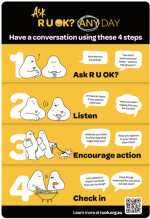
The R U OK? organisation provides a simple and effective four-step process for these conversations.

Step 1: Ask R U OK?

Approach the conversation with concern. Be relaxed, friendly, and genuine. You could say something like:
  • “Hey, you’ve seemed a bit quiet lately. Is everything okay?”
  • “I’ve noticed you’ve been a little stressed. How are you doing?”
  • “Just wanted to check in. R U OK?”
If they don’t want to talk, don’t criticise them. Instead, you could say, “Let me know if you ever want to chat”.

Step 2: Listen without judgement

This is the most crucial part. They might not have all the answers, and that’s perfectly fine. Your job is to listen openly and without interruption.
  • Ask open-ended questions that encourage a longer answer. Instead of “Did you have a good day?” try, “How has your week been?”
  • If they need time to think, sit in the silence with them. It can feel uncomfortable, but it shows you’re taking them seriously.
  • If you’re unsure about what they mean, repeat back what you’ve heard in your own words. For example, “It sounds like you’re feeling a bit overwhelmed. Is that right?”

Step 3: Encourage action

If they’ve shared that they’re not okay, you can empower them to take the next step.
  • Ask them what they’ve done in the past to manage similar situations.
  • Offer your support: “What can I do to support you?” or “I’m here for you, no matter what.”
  • If they’ve been feeling down for two weeks or more, gently suggest they seek professional help. You can say, “It might be helpful to chat with a professional. I can help you look up some options if you’d like.”

Step 4: Check-in

Your support doesn’t end after one conversation. The follow-up is vital.
  • Set a reminder to check in with them in a few weeks. A simple text or call can make a world of difference.
  • Don’t judge if they haven’t found a solution. Just ask how they’re going and if there’s anything else you can do to help.
  • Make it easy for them to reach out: “If you need to talk before then, call me anytime—even if it’s 2 AM.”
  • Be consistent: Follow through on your promises. Unreliability can reinforce feelings of abandonment.

Keep the conversation going

R U OK? Day is just the beginning. The skills you develop can be used throughout the year to strengthen relationships.

Let’s commit to reaching out and checking in with each other. A simple question can save a life. You already have the most important qualification for this conversation: you care about someone. That’s enough to start. Trust that your willingness to ask and listen can make a profound difference. And remember: perfect conversations don’t save lives, genuine ones do.

This R U OK? Day, choose one person to check in with. Send them a message, invite them for coffee, or simply ask, ‘How are you really going?’. That one question could change everything.

1 in 4 people might hesitate to ask even when they think someone is struggling. That's why today we're reminding everyone that if someone's on your mind, trust your instinct and start a conversation.

If you’re thinking it, Ask R U OK? Any Day because what people value most is trust, a sense of genuine care, and someone who really listens to them, without judgement.

Ask R U OK? Any Day because a conversation could change a life.

Caring is about us all.

R U OK?


1788990308142.png
 
Not just today but every day. If you think someone seems to be struggling with something just check in with them, it doesn’t need to be the Spanish Inquisition, just a casual chat or phone call. Some people really struggle with admitting that they are not ok & just knowing someone cares can often make the world of difference to them.
 
Our Wests Tigers Forum superstar @Suzie-Q is walking today to raise money for suicide prevention. The details are in the Mental Health thread in the general forum. If you would like to help by making a donation, the details & link to donate are in the post.

Finished!
 

Attachments

  • Screenshot_20260910_085014_Samsung Health.jpg
    Screenshot_20260910_085014_Samsung Health.jpg
    378.8 KB · Views: 0

Latest posts

Back
Top