September 24 falls in the middle of International Week of Deaf People, a week-long national celebration of Deaf individuals and the Australian Deaf community. This includes celebrating the International Week of Deaf People (IWDP) and International Day of Sign Languages (IDSL) which are initiatives of the World Federation of the Deaf (WFD).
These two events are traditionally held during September and are based on the founding date of the WFD (23 September 1951). National Week of Deaf People is an opportunity for Deaf people to celebrate their communities, language, culture and history; make the public aware of their local, state and national Deaf communities; and to recognise their achievements.
This year’s theme is "Declaring Deaf People’s Human Rights."
We adopt the World Federation of the Deaf’s daily themes for the International Week of Deaf People for use throughout NWDP.
The 2026 daily themes are:
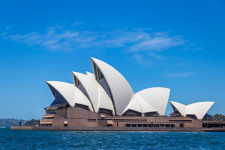
On the International Day of Sign Language, the World Federation of the Deaf invites all public places, public landmarks and official buildings, Presidential houses, County buildings, City Halls, and others to be spotlighted in blue light. Highlighting the colour blue is a reaffirmation of our joint commitment to supporting national sign languages and showing solidarity with global deaf communities. Together, we can achieve human rights and a more equal society via the use of national sign languages in all areas of life.
The Blue Light Challenge is a unique opportunity for national governments to partner with their national associations of deaf people in achieving the human rights of their deaf communities.
This year there is also a new global initiative: the Deaf Flag Raising. This symbolic action would consist of raising the Deaf flag in public spaces, deaf associations, schools, businesses, and government institutions to celebrate the deaf people and promote the visibility, recognition, and cultural heritage of deaf communities.
The Deaf Flag is a powerful symbol for deaf communities, representing unity, recognition, and the ongoing fight for equal rights. In 2023, the XX General Assembly of WFD officially approved the Deaf Flag.
Turquoise Blue represents the deaf community and Sign Language, pride and unity. Yellow represents the colour of light, an enlightened spirit, life and “thriving in unison”. Dark Blue represents the earth, humanity and living in accordance with the planet. It is also the color of the WFD, our logo is blue, we wear blue ribbons in support of deaf people, and deaf cultures all over the world recognize blue as representing deaf people. On the International Day of Sign Languages, we even celebrate by shining a blue light! Blue is deeply connected to the roots of the deaf community.
All of these colours together represent an awareness of humanity as inherently diverse, a diversity of peoples and languages on Earth. This flag shows that we are here, we belong to this world, we are a part of humanity. Deaf people are a part of a rich diversity that makes humanity better.
Hearing loss is more common than many people realise, with Ear Science Institute Australia research showing that 1 in 6 Australians experience some degree of hearing loss.
Hearing loss can be caused by:
Over 5.46 million Australians live with some form of hearing loss or ear disorder, making it one of the nation's most widespread health challenges, with prevalence projected to reach 1 in 4 people by 2050.
Prevalence and Demographics: Hearing loss is heavily linked to aging and noise exposure, affecting roughly 1 in 5 Australians currently. It disproportionately impacts older adults, men, and regional communities, with rates up to 10 times higher among Aboriginal and Torres Strait Islander populations.
Childhood Screening: Here in Australia, one out of every 1,000 children is diagnosed at birth with a permanent hearing loss, usually identified through newborn hearing screening. By the time they reach school age, 2 in every 1,000 children are diagnosed as having a hearing loss. This is because some cases of hearing loss develop after birth.
Hearing loss in children can develop at any time, even if they passed their newborn hearing screening. It can be temporary, caused by conditions like ear infections or wax blockage, or permanent due to illness, accidents, or genetic reasons.
When children have a hearing loss, they cannot hear certain sounds or parts of conversations. This depends on what type of hearing loss they have and whether it is mild, moderate, severe or profound.
Support and Funding Pathways: Eligible Australians—including pensioners, veterans, and young people under 26 - can access subsidized or free hearing services through the federal Hearing Services Program (HSP), while individuals with permanent and significant impairments may qualify for support via the National Disability Insurance Scheme (NDIS).
Prevention and Advocacy: The national peak body Deafness Forum Australia notes that up to 50% of hearing loss cases are entirely preventable through public education, workplace noise-safety standards, and early intervention.
So, IWDP is relevant to so many Aussies, and all those they connect with. This week promotes awareness related to sign languages and the people who use them. In addition, the desire is to create a society that has a greater understanding and embraces the diversity of everyone, including people who are deaf or hard of hearing.
So, we just need to listen up!
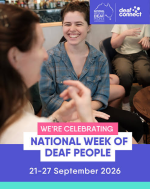
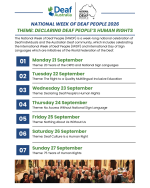
These two events are traditionally held during September and are based on the founding date of the WFD (23 September 1951). National Week of Deaf People is an opportunity for Deaf people to celebrate their communities, language, culture and history; make the public aware of their local, state and national Deaf communities; and to recognise their achievements.
This year’s theme is "Declaring Deaf People’s Human Rights."
We adopt the World Federation of the Deaf’s daily themes for the International Week of Deaf People for use throughout NWDP.
The 2026 daily themes are:
- Monday, 21 September 2026 | 20 Years of the CRPD and National Sign Languages
- Tuesday, 22 September 2026 | The Right to a Quality Multilingual Inclusive Education
- Wednesday, 23 September 2026 | Declaring Deaf People’s Human Rights
- Thursday, 24 September 2026 | No Access Without National Sign Language
- Friday, 25 September 2026 | Nothing About Us Without Us
- Saturday, 26 September 2026 | Deaf Culture is a Human Right
- Sunday, 27 September 2026 | 75 Years of Human Rights
On the International Day of Sign Language, the World Federation of the Deaf invites all public places, public landmarks and official buildings, Presidential houses, County buildings, City Halls, and others to be spotlighted in blue light. Highlighting the colour blue is a reaffirmation of our joint commitment to supporting national sign languages and showing solidarity with global deaf communities. Together, we can achieve human rights and a more equal society via the use of national sign languages in all areas of life.
The Blue Light Challenge is a unique opportunity for national governments to partner with their national associations of deaf people in achieving the human rights of their deaf communities.
This year there is also a new global initiative: the Deaf Flag Raising. This symbolic action would consist of raising the Deaf flag in public spaces, deaf associations, schools, businesses, and government institutions to celebrate the deaf people and promote the visibility, recognition, and cultural heritage of deaf communities.
The Deaf Flag is a powerful symbol for deaf communities, representing unity, recognition, and the ongoing fight for equal rights. In 2023, the XX General Assembly of WFD officially approved the Deaf Flag.
Turquoise Blue represents the deaf community and Sign Language, pride and unity. Yellow represents the colour of light, an enlightened spirit, life and “thriving in unison”. Dark Blue represents the earth, humanity and living in accordance with the planet. It is also the color of the WFD, our logo is blue, we wear blue ribbons in support of deaf people, and deaf cultures all over the world recognize blue as representing deaf people. On the International Day of Sign Languages, we even celebrate by shining a blue light! Blue is deeply connected to the roots of the deaf community.
All of these colours together represent an awareness of humanity as inherently diverse, a diversity of peoples and languages on Earth. This flag shows that we are here, we belong to this world, we are a part of humanity. Deaf people are a part of a rich diversity that makes humanity better.
Hearing loss is more common than many people realise, with Ear Science Institute Australia research showing that 1 in 6 Australians experience some degree of hearing loss.
Hearing loss can be caused by:
- genetics
- complications during birth
- premature birth
- jaundice
- infections or illnesses
- chronic middle ear fluid.
Over 5.46 million Australians live with some form of hearing loss or ear disorder, making it one of the nation's most widespread health challenges, with prevalence projected to reach 1 in 4 people by 2050.
Prevalence and Demographics: Hearing loss is heavily linked to aging and noise exposure, affecting roughly 1 in 5 Australians currently. It disproportionately impacts older adults, men, and regional communities, with rates up to 10 times higher among Aboriginal and Torres Strait Islander populations.
Childhood Screening: Here in Australia, one out of every 1,000 children is diagnosed at birth with a permanent hearing loss, usually identified through newborn hearing screening. By the time they reach school age, 2 in every 1,000 children are diagnosed as having a hearing loss. This is because some cases of hearing loss develop after birth.
Hearing loss in children can develop at any time, even if they passed their newborn hearing screening. It can be temporary, caused by conditions like ear infections or wax blockage, or permanent due to illness, accidents, or genetic reasons.
When children have a hearing loss, they cannot hear certain sounds or parts of conversations. This depends on what type of hearing loss they have and whether it is mild, moderate, severe or profound.
Support and Funding Pathways: Eligible Australians—including pensioners, veterans, and young people under 26 - can access subsidized or free hearing services through the federal Hearing Services Program (HSP), while individuals with permanent and significant impairments may qualify for support via the National Disability Insurance Scheme (NDIS).
Prevention and Advocacy: The national peak body Deafness Forum Australia notes that up to 50% of hearing loss cases are entirely preventable through public education, workplace noise-safety standards, and early intervention.
So, IWDP is relevant to so many Aussies, and all those they connect with. This week promotes awareness related to sign languages and the people who use them. In addition, the desire is to create a society that has a greater understanding and embraces the diversity of everyone, including people who are deaf or hard of hearing.
So, we just need to listen up!