In December 1943, a young American pilot named Charlie Brown was flying his first combat mission in a B‑17 bomber called Ye Olde Pub. Over Germany, the bomber was torn apart by flak and fighters, engines dead, tail shredded, crew wounded, oxygen gone. The plane was so damaged that German pilots later said it looked like “a ghost trying to stay in the air.”
Brown was barely conscious, fighting the controls, trying to keep his crew alive.
Then a German Messerschmitt Bf 109 pulled up alongside the dying bomber.
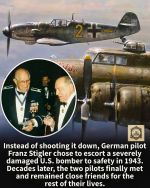
The German pilot, Franz Stigler, was an ace. One more kill would earn him the Knight’s Cross. He had every reason and every order to finish the job.
But when he saw the bomber’s condition, the wounded crew, and the terrified tail gunner slumped over his gun, Stigler made a decision that could have gotten him executed:
He refused to shoot.
Instead, he flew beside the bomber, protecting it from German anti‑aircraft guns and other fighters. He even tried to signal Brown to land and surrender so the crew could get medical care. Brown refused, he had to get his men home.
So Stigler escorted the bomber all the way to the North Sea, saluted Brown… and turned back.
Brown never told anyone the story. Stigler never told anyone either, protecting an enemy was a court‑martial offense.
Nearly 50 years later, Brown searched for the mysterious German pilot who spared him. When they finally met in 1990, Stigler walked toward Brown with tears in his eyes and said:
“I was the one.”
From that moment on, the two men became inseparable, calling each other weekly, visiting each other’s families, and speaking at events together.
They died months apart in 2008.
Their story is now known as “The War Story With No Enemy.”

 northernbeachesliving.com.au