Only a matter of time before our lot raise them one.
View attachment 44839
Thanks for posting this mtd2
This really is food for thought regarding NRL interventions.
1.
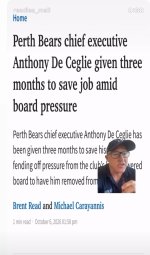
The Perth Bears: Orderly Process & Strict Compliance
The Bears' expansion constitution explicitly strips the local board of the power to unilaterally sack the chief executive. Ultimate authority rests with the ARLC and Chairman Peter V'landys. Rather than executing an illegal coup, the Bears board brought their grievances directly to head office for formal review.
The NRL exercised its veto to block the immediate dismissal.
2.
Holman Barnes Group (HBG): Non-Compliance, Public Humiliation & Repeat Offenses
In contrast, Holman Barnes Group (HBG) acted in direct violation of basic corporate governance, resulting in a damaging public backflip.
The Double Breach: HBG unilaterally sacked Chairman Barry O'Farrell and three independent directors. This violated the Wests Tigers Company Constitution (which mandated strict consultation processes) and breached their NRL Club Operating Licence (which requires an independent majority board).
Public Humiliation: Because HBG's move was procedurally invalid, the NRL issued a stark ultimatum, reinstate the independent directors or risk immediate suspension of their operating licence. HBG was forced into a complete backflip within 10 days, suffering severe reputation damage, public member protests, and widespread media ridicule.
A History of Repeat Offenses, Why HBG Cannot Be Trusted & Future Turmoil Remains Guaranteed.
By accepting HBG's forced reinstatement as a resolution, the NRL patched an immediate crisis but left the root vulnerability completely unaddressed.
Their history shows a clear pattern, when independent leadership makes decisions HBG dislikes, HBG attempts to reassert control.
The NRL could have stripped the operating licence, enforce mandatory ownership dilution, and alter HBG's voting weight, but the NRL chose to leave an outmoded governance model in place, leaving the Wests Tigers permanently exposed to future boardroom volatility.